
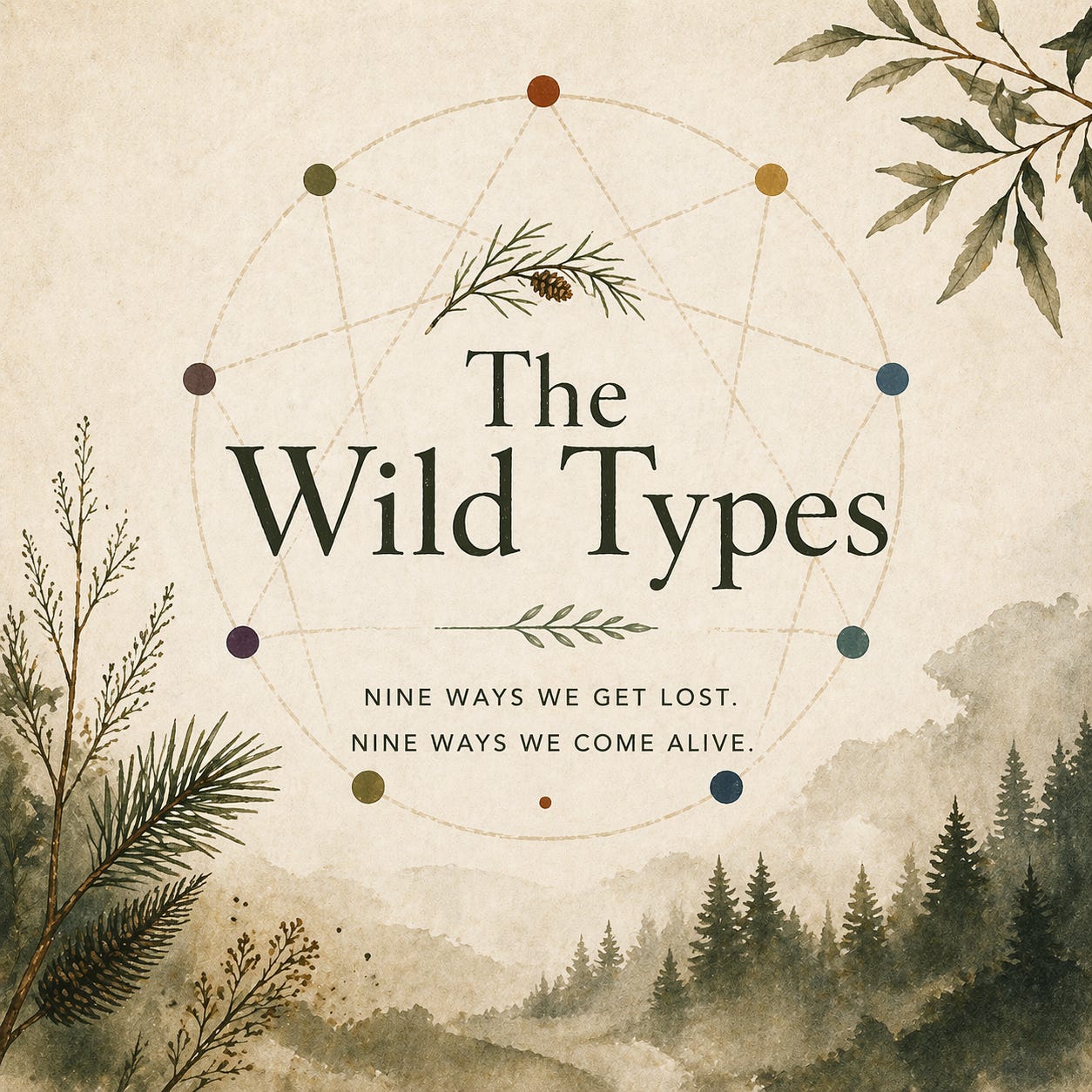
Welcome to The Wild Types
Nine ways we get lost. Nine ways we come alive.

Why I Created This Space
I recently completed a course called Experiencing the Narrative Enneagram, and I find myself returning to it again and again.
It didn’t happen during a lecture, or while studying the structure of the Enneagram, or even while trying to identify my type with any kind of certainty; instead, it emerged in the context of a simple, human conversation, where I sat in a small group with others who shared my type and listened as each person spoke from the inside of their own lived experience.
What struck me most was not just the accuracy of what I heard, but the resonance of it: the way their words seemed to bypass my usual filters and land somewhere deeper, as if they were naming something I had always known but never quite had the language to express; and in that moment, I realized that this was not about categorization or analysis, but about recognition.
It felt disarming in a way that is difficult to describe, because there was no need to explain myself or defend my way of being in the world; there was simply a shared understanding that allowed me to relax into my own story with a kind of honesty that felt, in its own quiet way, sacred.
That experience changed how I understand the Enneagram: it became an entry point for what I call The Wild.
Before the Type, the Circle
Long before I could name my type or understand the movement between numbers or recognize the patterns that shape my thoughts and behaviors, I was introduced to the Enneagram through a single image: a circle.
This wasn’t the full diagram, the lines and arrows and intricate geometry that many of us come to associate with the Enneagram, but a simple, unbroken circle that seemed to hold within it a deeper truth about who we are.
I was told that the circle represents wholeness, not perfection, not the absence of struggle, but the fundamental completeness of our being before we begin to organize ourselves around a particular way of navigating the world; before we learn the strategies that help us feel safe or valued or in control; before our personality takes shape in response to the conditions of our lives.
Before the “type,” there is something whole.
If we allow the circle to come first, then the Enneagram becomes something very different from a personality system that boxes us in or defines our limitations.
It becomes a map of how we have adapted, yes, but also a pathway back to something more spacious, more grounded, and more fully alive.
The types, in this sense, are not identities to cling to but doorways we can move through.
Why The Wild Types
I created The Wild Types because I wanted to cultivate a space where the Enneagram could be approached in this deeper, more expansive way, not as a tool for labeling ourselves or others, and not as a way of refining our personalities into something more socially acceptable, but as an invitation to gently loosen our grip on the patterns that no longer serve us. This is where my background as a minister, coach, and certified spiritual director begins to overlap with this incredible tool of self- and inter-personal discovery.
The word wild is important to me because I’m not referring to something chaotic or impulsive or ungrounded, but rather to something original: something that exists prior to all the ways we have learned to shape ourselves in order to belong.
To be wild, in this sense, is to be fully and authentically ourselves, not in a reactive or performative way, but in a way that feels rooted, spacious, and deeply aligned with who we were always meant to be.
What I have come to see, both in my own life and in the lives of others, is that our Enneagram type, while incredibly insightful and often uncannily accurate, can also become a kind of enmeshment, a pattern so familiar that we begin to mistake it for the entirety of who we are.
We say, “This is just how I am,” without always realizing how much of that statement is shaped by adaptation rather than essence.
But when we begin to loosen that identification, even slightly, when we start to notice our patterns without immediately acting on them, when we create space between our instincts and our responses, we begin to experience something different.
We begin to think in ways that feel more open and less constrained. We begin to feel with greater depth and less defensiveness. We begin to act with a kind of freedom not driven by fear or compulsion, but by presence.
In other words, we begin to return to something wild.
Not a new version of ourselves, but a truer one.
Who I Am (and Why This Matters to Me)
My name is Michael, and I am a pastor, coach, and spiritual director, and someone who has spent much of his life paying attention to the deeper questions that shape how we live and relate to one another.
In my work, I have the privilege of sitting with people in moments of honesty, having conversations about what they value, what they fear, what they hope for, and what they want their lives to mean, and again and again, I find that beneath all of those questions is a quieter, more essential one:
Who am I, really?
Not who I have learned to be in order to navigate the expectations of others. But who am I beneath all of that?
My spirituality is rooted in a progressive Christian tradition that centers compassion, justice, and the inherent worth of every person, and it has been deeply shaped by contemplative practices that emphasize awareness, presence, and the slow unfolding of transformation over time.
If there is one thing I have come to believe, it is that real change does not come from force, self-criticism, or the relentless pursuit of improvement.
It comes from creating enough space within ourselves that something new can begin to emerge.
The World I Hope For
The Enneagram, for me, is not only a tool for personal insight, but a doorway into a different way of being in the world together.
We are living in a time that often rewards immediacy over reflection, certainty over curiosity, and reactivity over understanding, and it is all too easy to become entrenched in the very patterns that keep us divided from one another.
But the Enneagram offers us another possibility.
It helps us see the automatic ways we interpret the world and respond to it.
It invites us to pause, even briefly, before those patterns take over.
It reminds us that we are not limited to our first instinct, our loudest fear, or our most familiar story.
And when we begin to live with that kind of awareness, we start to change.
We become more compassionate, because we recognize how much of our behavior, and the behavior of others, is shaped by unconscious patterns. We become more curious, because we no longer need to defend our perspective as the only valid one. We become more grounded, because we are no longer being pulled in every direction by the need to protect or prove ourselves.
This is the kind of world I long to be part of, one where people are not reduced to their patterns, where growth is not only possible but expected, and where we can meet one another with a depth of understanding that transcends our differences.
An Invitation
If you’ve found your way here, there’s likely something in you that is already reaching toward this kind of exploration, whether you would describe it as curiosity, longing, or simply a quiet sense that there is more to who you are than you have yet discovered.
This space is for that.
In this space, I will be sharing reflections, practices, and conversations shaped by the Enneagram, but always with the circle in mind, always returning to the idea that wholeness is not something we achieve, but something we remember.
You do not need to become someone else in order to grow.
You do not need to fix everything that feels incomplete.
You only need to begin noticing, gently, honestly, and with as much compassion as you can offer yourself, what patterns are shaping your life, and what might become possible if those patterns loosen, even just a little.
And maybe, together, we can learn how to live from that place. So, let’s get Wild, shall we?